Modernising legacy estates is rarely just a migration challenge. It is a knowledge challenge. Business logic is deeply embedded in ageing systems, documentation is incomplete, and dependencies are often invisible. LACE addresses that complexity directly by turning legacy assets into structured, actionable intelligence.
With support for Assistant Mode and Agent Mode, LACE helps teams move from code understanding to transformation design and execution with greater speed, consistency, and engineering confidence.
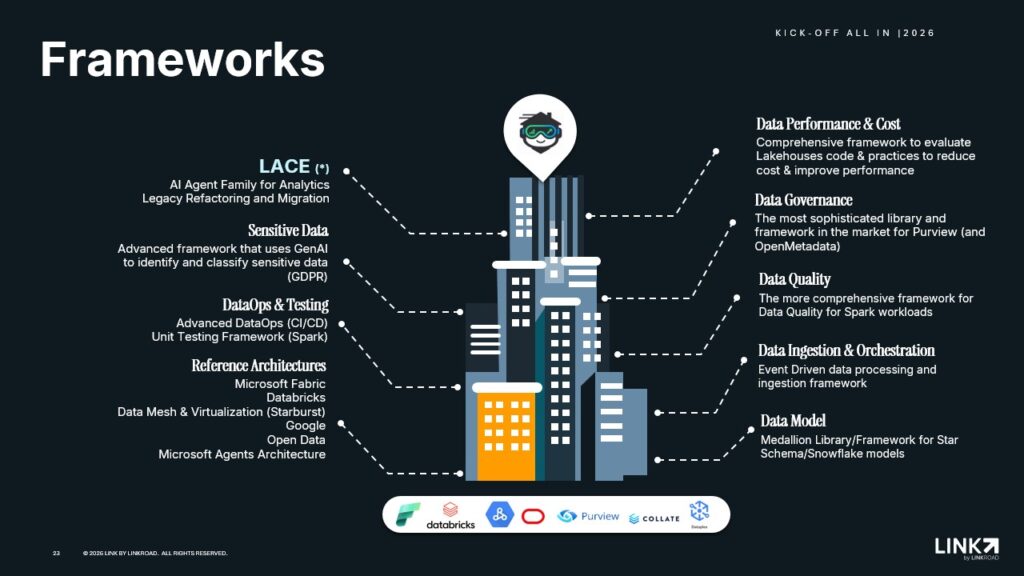
Understand legacy
LACE gives engineering teams a detailed understanding of legacy codebases through code explanation, AST analysis, lineage mapping, data model interpretation, and component-level complexity assessment. It helps make opaque systems readable again.
By exposing hidden dependencies, embedded rules, and undocumented behaviours, LACE reduces discovery effort and creates a stronger factual basis for modernization decisions. It replaces assumptions with evidence.
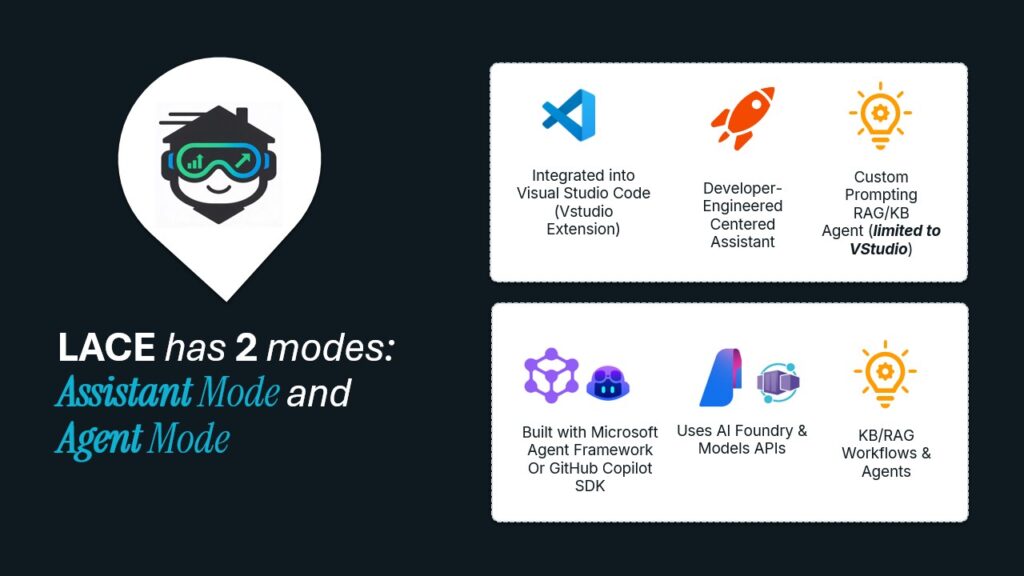
Assistant mode
A developer-centred experience for understanding, analysing, and preparing legacy transformation.
In Assistant Mode, LACE supports developers directly inside their working environment, helping them inspect code, understand legacy structures, analyse business logic, and interpret target transformation paths with greater efficiency.
It can also leverage RAG and knowledge-base mechanisms to address edge cases, unsupported code patterns, or customer-specific migration requirements, helping teams go beyond generic AI outputs and work with context that is relevant to the real environment.
Agent mode
A structured path from analysis to generated modernization outputs.
In Agent Mode, LACE expands from assisted understanding into orchestrated modernization tasks. Agents can interpret legacy assets, design target data models, and support the generation of transformation pipelines aligned with the destination architecture.
This includes extracting business logic from legacy engines and generating SparkSQL or PySpark artefacts required for modern execution layers. The result is a more controlled, more scalable approach to migration delivery.
Platform and scope
Designed for modern engineering teams and adaptable to different legacy estates.
LACE is currently available for Oracle, with additional roadmap coverage for SAS, SAP BW, and Cloudera. This makes it relevant for organisations operating across heterogeneous legacy data environments with different modernization priorities.
The framework is integrated with Visual Studio Code and built on technologies such as Microsoft Agent Framework, GitHub Copilot SDK, AI Foundry, and enterprise knowledge-base patterns, enabling a practical and extensible architecture for real modernization programmes.