Articles
Agentic Infrastructure: What It Is and How to Build It
A practical, plain-terms guide to what agentic infrastructure actually is and how to build it.




Published: Aug 28, 2026 – Last updated: Oct 02, 2026 – Reading time: 35 minutes
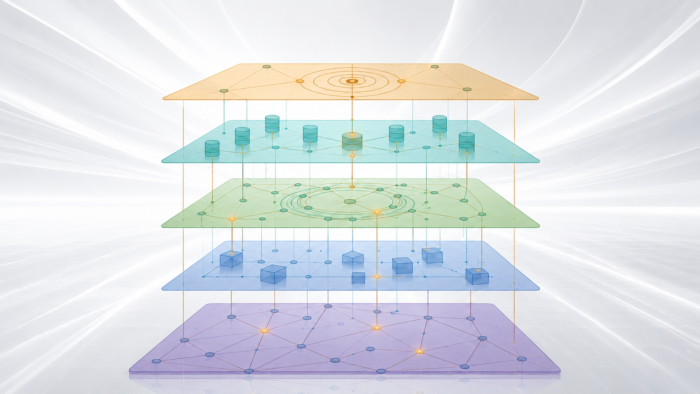
Agentic infrastructure is the technical foundation that lets an AI agent decide its own steps toward a goal, within the limits you define, not just answer a question. This article explains what that means in plain terms, walks through exactly how it works, and covers the pillars, protocols, frameworks, and architecture choices you’ll actually run into if you’re building or evaluating one.
Elsewhere, you may see “agentic infrastructure” used in a different sense: cloud infrastructure that AI agents provision and operate through code. This is a distinct use of the term. This article is about the stack an agent runs on, not the stack an agent manages.
What Is Agentic Infrastructure?
Agentic infrastructure is the set of systems (runtime, orchestration, memory, state, tool access, observability, and security) that lets an AI agent take a goal, decide what to do, take action, and keep going across multiple steps, instead of just responding to a single prompt and stopping.
The word “agentic” gets used loosely, so it’s worth being precise: it doesn’t mean fully autonomous in the sense of “does whatever it wants.” A well-designed agent operates inside boundaries someone defined, with specific tools it’s allowed to call, specific data it’s allowed to see, and specific actions that require a human to sign off. What makes a system agentic isn’t the absence of limits, it’s that the system decides how to reach a goal within those limits, rather than following a fixed script.
Agent, Chatbot, or Copilot? The Distinction Matters
A chatbot answers what you ask it and stops. A copilot suggests something and waits for a human to approve and execute it. An agent is a different animal: give it a goal, and it plans, calls tools, pulls in information, takes action, and adjusts as it goes, sometimes across dozens of steps, sometimes for hours.
| Chatbot | Copilot | Agent | |
|---|---|---|---|
| Initiative | Reactive | Collaborative | Goal-directed |
| Tool use | One tool, one answer | Suggests, human executes | Chains tools as needed |
| Task duration | Seconds | Minutes, one sitting | Minutes to hours |
| Execution | Waits for each input | Waits for each approval | Continues without input |
| Decision authority | None or limited | Advisory | Acts within defined limits |
Worth noting: chatbot, copilot, and agent describe how you interact with a system, not what the system is called. Plenty of tools marketed as copilots now behave like agents.
What Actually Makes Something an Agent
The table above shows the difference in behavior, but not the mechanism behind it. What separates an agent from the other two isn’t a bigger model or a longer prompt, it’s a loop. A chatbot takes an input and produces an output, full stop. An agent takes a goal, forms a plan, takes an action, looks at what happened, and decides whether to act again or stop, and it keeps running that loop, on its own, until the goal is met or it hits a limit it’s not allowed to cross. That loop, not the underlying language model, is the thing agentic infrastructure exists to support.
This is also why “agent” gets applied to such a wide range of products. The mechanism is the same; what differs is the domain and the scope of the loop.
- Coding agents – tools like Claude Code and GitHub Copilot’s agent mode read a codebase, write and edit files, run tests, and fix what breaks, in a loop, rather than suggesting one snippet at a time.
- Customer support agents – platforms like Salesforce Agentforce or Sierra look up account information, determine the appropriate resolution, and, when configured to do so, carry out actions such as changing a plan or processing a refund, rather than simply drafting a reply for a human to send.
- Browser and computer-use agents – tools such as Anthropic’s computer-use capabilities and ChatGPT’s browser features interact with real interfaces by clicking, typing, navigating, and filling out forms, allowing them to complete multi-step tasks across websites.
- Research agents – deep-research modes in tools like ChatGPT and Claude break a question into sub-questions, search and read dozens of sources, and synthesize a report, unsupervised, over several minutes.
- Operations agents – agents inside cloud and DevOps platforms watch for anomalies, look up the likely cause, and either fix it directly or escalate with a diagnosis attached.
The value of the agent layer isn’t that it’s faster at any one of these steps than a human would be. It’s that it can carry out the entire loop, including the judgment calls in the middle, without someone babysitting each step, and only interrupt a person for the parts that genuinely need their approval. A chatbot still needs a human to act on its answer. A copilot still needs a human to execute its suggestion. An agent is the first of the three that closes that loop itself, and that’s exactly why it needs so much more infrastructure underneath it than the other two.
The Spectrum of Agentic Systems
Knowing what makes something an agent is one thing. But in practice, almost nothing is purely one or the other.
Most systems sit somewhere on a continuum between “answers a question” and “runs the whole loop unsupervised.” That’s what the word “agentic” actually describes: not a fixed category a system either belongs to or doesn’t, but how much of that loop, planning, acting, checking the result, deciding whether to continue, a given system is trusted to run on its own.
A system can be “a little agentic” (it takes one action and stops) or “highly agentic” (it runs the loop for hours, across several coordinated agents, with minimal human involvement).
The table below breaks that continuum into practical tiers, and, more usefully, shows how much infrastructure each tier actually demands.
| Scope | Example | The Infrastructure Bar |
|---|---|---|
| One reply, no action | Answers a question, nothing happens outside the conversation | A model endpoint; almost nothing else |
| One action, then done | Looks something up or triggers a single API call before replying | Credential handling and a log of what was called |
| A goal, several steps | Plans a sequence of actions and carries them out in order, checking in when needed | State tracking across steps, retry handling, defined approval points |
| Several agents, one goal | Splits the work across specialist agents that hand tasks to each other | A way for agents to register, message each other, and be traced as a group |
Each level up doesn’t just add more of the same, it introduces entirely new failure modes. A system that takes one action can misfire on a single bad API call. A system coordinating several agents can misfire because two of them disagree, duplicate work, or get stuck waiting on each other.
Most production deployments today sit in the third row of that table: a goal broken into several steps, with a human checkpoint at the points that matter. That row has its own failure mode, too, a step early in the sequence goes wrong, or the checkpoint gets skipped, and the agent carries on for several more steps before anyone notices, by which point the mistake has compounded. Catching that requires real orchestration, state tracking, and tracing, not just careful prompting.
None of these failure modes are unsolvable, though. The infrastructure this article covers next, orchestration, observability, coordination between agents, exists specifically to catch and contain them, even if no single piece of it is a complete fix on its own.
That third row is worth seeing in action, not just in the abstract. The clearest way to understand what “orchestration,” “state tracking,” and “tracing” actually mean in practice is to walk through one real task from start to finish, and see exactly where each piece of infrastructure earns its place.
How Agentic Infrastructure Works
Say a customer tells a travel agent (the AI kind) that their flight got rescheduled, and asks it to move their hotel booking to match.
There’s more than one way to architect a system that handles this, single-agent or multi-agent, reactive or deliberative. The next section covers those variations.
But walking through one representative sequence end to end is the clearest way to see what each piece of infrastructure is actually for. So here’s how it plays out in a fairly typical deliberative, single-agent setup:
- The agent receives the goal – Not a search query, a goal: “make my hotel dates match my new flight.” This is where the runtime and compute layer picks up the request and starts a session.
- It pulls in context – It needs to know the original booking, the loyalty tier, the cancellation policy, none of which fits in a single prompt. This is the memory and retrieval layer, pulling structured facts from the booking system rather than guessing.
- It calls tools – It queries the hotel’s availability API for the new dates, checks whether the existing rate is still available, and checks the cancellation terms on the current reservation. This is the tool integration layer, and every one of these calls needs to be authenticated and logged.
- It reasons and re-plans – If the same room isn’t available, it looks for the closest equivalent and calculates the price difference. This is the orchestration layer managing a decision loop, not a single request and response.
- It hits a limit and checks in – The change would trigger a €150 fee. That’s above what the agent is authorized to approve on its own, so it pauses and asks the customer to confirm before proceeding. This is the guardrail layer doing its job, not a bug.
- It executes the action – Once confirmed, it cancels the old booking, confirms the new one, and sends a confirmation. This is the agent actually acting on external systems, not just describing what it would do.
- Every step gets logged – If the customer disputes the fee next week, someone needs to reconstruct exactly what the agent saw, decided, and did, in order. That’s the observability layer, and without it, that dispute is unresolvable.
None of these seven steps is unusual on its own. A human travel agent does this kind of thing routinely: checks availability, weighs the fee, asks before charging it, confirms the change.
What’s different when a machine does it is that nobody’s watching in between. Each step now needs its own system behind it, one that can be trusted to make the right call, log what happened, and stop at the right moment, without a person standing over its shoulder.
That’s the actual definition of agentic infrastructure: not the part that makes the decision, but everything that lets the decision get carried out reliably, safely, and in a way someone could reconstruct afterward.
The Five Pillars of Agentic Infrastructure
Mapping the example above onto a general architecture gives you five layers that any production agent needs.
Compute and Runtime
This is the layer that actually runs the AI model behind the agent, the servers and specialized chips (GPUs) doing the computation, and what starts and manages the session once a request comes in, like step 1 in the hotel example. Most teams never touch this directly: if you’re using a well-known AI model, that’s the provider’s problem, not yours. The one decision worth knowing about is whether to use a ready-made model through an API or self-host an open one on infrastructure you control, usually a question of data residency or regulatory requirements rather than preference.
Orchestration
This is the layer that runs the agent’s actual loop: deciding what to do next, calling the right tool at the right time, retrying when something fails, and pausing to ask a human when it hits a limit, exactly what happened at step 5 in the hotel example. Instead of following one fixed sequence, this layer works more like a map with several possible paths, letting the agent branch, retry, or hand part of the task off to a more specialized agent when needed.
Memory and Context
Agents need two kinds of memory: whatever fits in the current conversation, and long-term memory, a searchable store of past records the agent can draw on. The link between the two is a technique called retrieval-augmented generation, or RAG. At the moment it needs an answer, the agent searches that long-term store, pulls back the relevant records, the original hotel booking, the loyalty tier, and feeds them into the conversation in real time, instead of relying only on what the model picked up during training.
Context is different: it’s everything the agent has in front of it right now, the customer’s request, which tools it’s allowed to use, what step of the task it’s on. When RAG pulls a record from memory, that record becomes part of the context, it’s now something the agent can actually see and use to decide its next move. Memory is the full archive; context is the small, relevant slice of it the agent is working from at any given moment.
Observability
Every reasoning step, every tool call, every decision an agent makes needs to leave a trace, not just the final output. This means distributed tracing, increasingly built on OpenTelemetry, a mature, widely adopted open standard for collecting this kind of data in general. The specific conventions for tracing AI agents – what a “model call” or an “agent step” should look like as a data point – are newer and are currently in Development status under OpenTelemetry’s stability model, so expect some format changes as the space matures. Plus automated evaluation, and regression test sets built from real production traces, so a change in one part of the agent’s behavior doesn’t quietly break something else three steps downstream. This is what makes step 7 in the example possible at all.
Security, Guardrails, and Identity
Security here means containment: the agent should only be able to touch the systems and data it actually needs for its task, nothing more, so a mistake in one place can’t spread everywhere else.
Guardrails are the limits on what the agent can decide by itself. A rule like “don’t approve a fee above €150 without asking first” has to be built in as something the agent physically cannot override, the way it did at step 5 of the hotel example, not as a guideline it might ignore under the wrong conditions.
Identity means treating each agent as its own account, with its own restricted, temporary access, similar to a new employee getting a badge that only opens the doors their role requires, rather than everyone sharing one master key that never expires. It also means every action the agent takes gets recorded, so if something goes wrong later, there’s a clear record of exactly what it did and when.
The five pillars above describe the systems an agent needs. They don’t explain how an agent actually connects to a specific tool, or how it talks to another agent when a task needs to be split between them. That’s a separate problem, and it’s exactly what two protocols have emerged to solve.
MCP and A2A: The Protocols Standardizing Agents
Two protocols have emerged to standardize how agents connect to the world around them.
Model Context Protocol (MCP)
Anthropic introduced MCP in late 2024; since December 2025, it has been governed by the Agentic AI Foundation under the Linux Foundation. In July 2026, MCP received its largest revision since launch: its protocol core became stateless, removing the protocol-level session and allowing requests to be routed independently across standard HTTP infrastructure, which makes MCP servers much easier to run and scale. The same release introduced a formal extensions framework, including MCP Apps for interactive interfaces and Tasks for long-running operations.
It standardizes how an agent talks to external tools and data, the hotel API and booking system in the earlier example. People call it the USB-C of AI, and the comparison holds up: instead of a custom integration for every tool, you get one interface.
Here’s why that matters. Say a company has 3 AI agents that all need to use the same 3 tools, a booking system, a CRM, a payments system.
Without a shared standard, each agent needs its own custom connection to each tool: 3 agents times 3 tools is 9 separate connections to build and maintain. Add a fourth agent, and that’s 3 more connections on top of the 9.
With MCP, each agent and each tool only implements the standard once: 3 plus 3 is 6 connections instead of 9. Any MCP-compatible agent can then reach any MCP-compatible tool, with no custom connection needed between that specific pair. Add a fourth agent, and it only needs 1 new connection, to the shared protocol, not 3.
The diagram below shows both scenarios side by side.
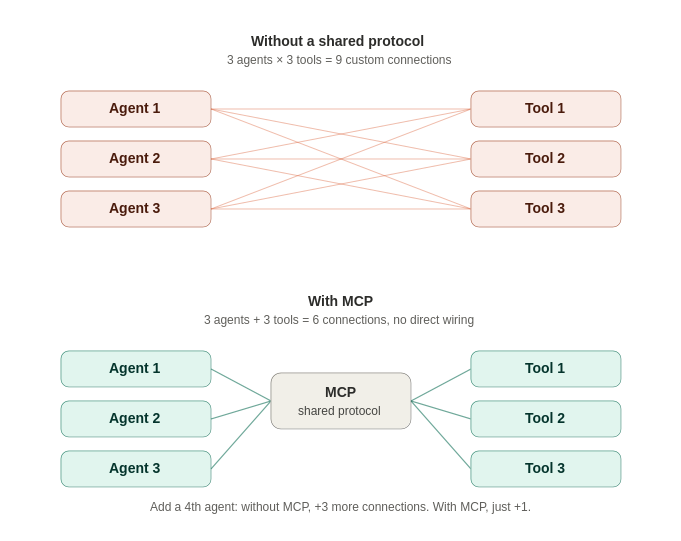
Without a shared protocol, 3 agents and 3 tools need 9 separate connections. With MCP, they need 6, and adding a 4th agent only needs 1 new connection instead of 3.
That efficiency is exactly why MCP spread so quickly: OpenAI, Microsoft, Google, AWS, Databricks, and Cloudflare have all adopted it.
One thing worth clearing up: you don’t always have to build this yourself. MCP has two sides: a piece of software that speaks the protocol for a specific tool (known as an MCP server), and another piece of software that speaks it for the agent (the MCP client), and a lot of both already exist.
Agent platforms like Claude and ChatGPT already know how to speak MCP out of the box. And for the tools in the hotel example, Booking.com, HubSpot, and Stripe have all published their own official connectors, for hotel search and availability, CRM data, and payments respectively, though some, like Booking.com’s, require a partner agreement.
Where you actually need to build something is for your own internal, custom systems, a proprietary booking platform, a legacy database, an in-house CRM, that don’t have a connector yet. In that case, someone has to build that connector once, and after that, any MCP-compatible agent can use it. The protocol itself keeps evolving, though, so connectors built against earlier versions of the specification may need updating over time. It’s worth treating them as maintained software, not a one-off build.
Agent2Agent (A2A)
Google introduced A2A in April 2025, released under Apache 2.0 (a standard open-source license). It moved to the Linux Foundation in June 2025 and, since August 2026, has been part of the Agentic AI Foundation, alongside MCP.
MCP solves a different problem than A2A does. MCP is about an agent reaching a tool it needs, a booking system, a payments API. A2A is about two separate agents, possibly built on different platforms, working together on the same task. That’s a real gap MCP doesn’t cover: nothing in MCP tells one agent how to find another agent, check what it’s capable of, hand off part of a job to it, and trust what comes back.
A2A solves this with something called an “Agent Card”, essentially a machine-readable profile an agent publishes about itself: what it can do, what information it needs to do it, and what it returns. One agent can look at another’s Agent Card and immediately know whether it’s the right one to delegate a task to, without a developer writing custom integration code first. Since version 1.0, Agent Cards can also be cryptographically signed, so an agent can verify that a card is authentic and comes from its claimed provider before delegating part of a task to that agent.
Here’s how that plays out in the hotel example. Say the travel agent handling the booking is built on Claude, but the company’s customer support history, past complaints, loyalty status notes, lives inside a separate support agent built on ChatGPT. Instead of duplicating that support agent’s work, the Claude-based travel agent uses A2A to ask it directly: has this customer had issues with date changes before? The ChatGPT-based agent checks its own records and answers, and the travel agent folds that into its decision, all without either agent needing to know how the other one was built.
The mechanics underneath: since version 1.0, released in March 2026 as the protocol’s first stable version, A2A runs on standard, widely used web and service technologies (JSON-RPC, gRPC, or plain HTTP with JSON), so teams don’t need special infrastructure to adopt it. For longer tasks, an agent can keep sending progress updates as the work happens, instead of replying only once at the end.
How They Fit Together
In practice, the two protocols combine into flows more complex than either one alone. An agent might use MCP directly to check a tool, or decide the task actually needs another agent’s expertise and reach out over A2A instead, and that second agent might then use MCP itself to complete its part. In the hotel example: the travel agent could hand part of the task to the support agent over A2A, and that support agent might then use its own MCP connection to look something up, a full chain, not just a single hop.
A common way teams organize this is with one orchestrator agent at the center, the one deciding whether to handle something directly or delegate it, while specialist agents handle narrower pieces of the work. It’s worth being clear that A2A doesn’t replace MCP, and MCP doesn’t solve coordination between agents; each protocol does one job, and most production systems end up needing both.
One practical consequence as these chains get longer: not every agent should be able to reach every tool, or talk to every other agent. Defining who can do what is exactly the job of the security and identity pillar covered earlier, and it needs to be designed in from the start, not added as an afterthought.
Knowing how these protocols work is one thing. Actually building an agent that uses them well is a separate question, and that’s where a framework comes in. Here’s the toolkit landscape as it stands.
Frameworks and Tools You’ll Actually Encounter
Building an agent, in practice, comes down to a stack of decisions: which model to use, how to structure its reasoning loop, how to connect it to tools, how to coordinate it with other agents if needed. You could write all of that from scratch, but almost nobody does. Instead, teams pick a framework that already handles most of it, and the right one depends less on which is “best” and more on what you’re actually trying to build.
Broadly, there are three main approaches that solve different problems: the first two are frameworks, code libraries a developer builds with; the third skips code entirely, no-code tools that let you assemble an agent visually.
If you’re already committed to one AI provider, its own SDK is usually the simplest starting point: it’s built specifically for that provider’s models and gets first access to new features.
- OpenAI Agents SDK – OpenAI’s own toolkit for building agents that use tools, hand off tasks, and run multi-step workflows on its models.
- Claude Agent SDK – Anthropic’s toolkit for building agents on Claude, including the coding-agent patterns behind Claude Code.
- Google Agent Development Kit (ADK) – Google’s framework for building agents that integrate natively with its Gemini models and A2A protocol.
- Mistral Agents API – the French AI lab’s own toolkit for building agents on its models, with native MCP support and a European data residency option.
If you want to mix models, or need more control over how agents plan and coordinate, a cross-platform framework gives you that flexibility, at the cost of more setup work.
- LangGraph – graph-based orchestration for agent workflows, giving developers explicit control over how they branch, retry, and hand off between steps.
- CrewAI – organizes multiple agents into defined “roles” that collaborate on a shared task, popular for multi-agent setups.
- Microsoft Agent Framework (the unified successor to Microsoft’s earlier AutoGen and Semantic Kernel projects) — Microsoft’s framework for building and coordinating multiple agents, integrated with its enterprise stack.
- LlamaIndex Workflows – built on top of LlamaIndex’s retrieval tooling, aimed at agents that lean heavily on document and data retrieval.
- Haystack Agents – deepset’s agent tooling, built on the same open-source stack as its retrieval framework.
If you don’t have dedicated engineering resources, a no-code platform trades some flexibility for a much faster start.
- n8n – a German-built no-code/low-code automation platform that has added agent nodes, a common starting point for teams without dedicated engineering resources.
- Zapier – the best-known no-code automation platform, now with an AI agent builder on top of its existing library of thousands of app integrations.
- Coze – ByteDance’s no-code agent builder, strong on templates and multi-channel deployment (Slack, Discord, websites); some enterprises weigh the parent company’s ownership when evaluating it for sensitive data.
None of these is universally “best.” The right choice depends on whether you’re building single-agent or multi-agent systems, how much you want to write yourself versus configure, and which model provider you’ve already standardized on.
Types of Agentic Architectures
Picking a framework or a no-code tool is one decision. Once you have one, there’s a second, separate decision still ahead: how the agent itself should be structured. That comes down to four independent choices, how many agents are involved in the task, how much planning happens before acting, whether the system sticks to one mode throughout or switches depending on the situation, and how its control flow actually gets implemented. None of these is right or wrong on its own, they’re trade-offs, and most production systems end up mixing approaches rather than picking one extreme.
Single-Agent vs. Multi-Agent
A single-agent system uses one model instance to receive a goal, call tools, and complete a task, this is what the hotel-rebooking example was. It’s simpler to build, observe, and debug, and it’s the right starting point for most teams. A multi-agent system splits the work across specialized agents (a research agent, a booking agent, a billing agent) coordinated by an orchestration layer. It scales better to complex work, but introduces new problems: shared state, message passing between agents, and failures that cascade from one agent to another instead of staying contained.
One detail worth knowing: a multi-agent system doesn’t always mean a fixed team decided in advance. Some orchestrator agents create sub-agents on the fly, spinning up a new one for a sub-task, letting it run, then folding its result back in and discarding it. In the hotel example, if three alternative rooms needed checking at once, the travel agent could spin up three temporary sub-agents to check each one in parallel, then discard them once it had an answer. That flexibility is powerful, but it’s also exactly why cost and debugging get harder at scale, a point we’ll come back to.
Reactive vs. Deliberative Agents
A reactive agent responds to a trigger with a predefined action and doesn’t maintain much state, fast, predictable, and well suited to high-volume, low-complexity work like initial ticket triage. A deliberative agent builds an internal plan, reasons about multiple possible actions, and chooses between them before acting, which is what happened at step 4 of the hotel example when the agent had to weigh alternatives. Deliberative agents handle complexity better but cost more per decision and need more sophisticated state management.
Loops vs. Graphs
There’s also a lower-level choice about how an agent’s control flow actually gets built, once the bigger questions above are settled. The simplest option is a loop: the agent takes an action, looks at the result, and decides on the next step, one at a time, close to what happened across the seven steps of the hotel example. Lightweight frameworks, sometimes called “harnesses,” lean on this pattern and keep the code close to that simple loop. The alternative is an explicit graph, mapping out possible steps and transitions in advance, trading some simplicity for more predictable, auditable behavior on complex, branching tasks. Neither replaces the choices above, it’s a separate decision about how much structure to wrap around the loop itself.
Hybrid Systems
Most real production deployments combine both: a fast reactive layer handles routine cases, and a deliberative agent takes over when a case gets complicated enough to need real reasoning. That combination is powerful, but it means the orchestration layer has to route between the two agent types and still produce one unified trace of what happened, which is exactly the kind of thing that’s easy to describe and hard to build well.
Step back for a second and look at everything covered so far.
The five pillars are the raw systems: compute, orchestration, memory, tools, security. MCP and A2A are the protocols that let those systems actually talk to tools and to each other. The framework is what you build the agent with. The architecture is how you structure it, one agent or several, reactive or deliberative.
Put together, that’s what “agentic infrastructure” has meant throughout this article: not one system, but the full stack that has to work for an agent to run reliably.
The next question is what all of that is actually for; what a company gets in return for building it.
Benefits of Agentic Infrastructure
A poorly built agent can still answer a question or two. What good agentic infrastructure actually buys a company is being able to rely on that agent at scale, with real customers, day after day. The four benefits below are what that reliability looks like in practice.
- Fewer cases need a person at all. Traditional automation follows a fixed path and hands off anything unusual to a human, exceptions, edge cases, judgment calls. This is what the orchestration layer and its guardrails, two of the five pillars covered earlier, actually buy a company: in the hotel example, a scripted system would stop the moment the exact room type wasn’t available, but an agent, backed by that infrastructure, can evaluate the alternatives and keep going, stopping only when a real limit is hit. The result is a smaller pile of cases waiting on a person.
- One agent can support thousands of customers at once. This is the compute and runtime layer, another one of those same five pillars, at work: autoscaling means an agent handling one conversation or ten thousand keeps the same quality, escalating only the cases that genuinely need a human. Salesforce’s own Help portal has handled 4.3 million support inquiries through Agentforce, resolving 70% of them (as of June 2026).
- Edge cases don’t require an engineer to fix them. This comes from the memory and context layer, a third of the five pillars: instead of following a fixed rule, a well-built agent pulls in the actual current record, an updated policy, a changed price, and reasons through the new situation with it, the way a person would. That means fewer support tickets sitting in an engineering backlog waiting for a code change.
- It shifts human attention to where it matters. This is guardrails again, the same pillar from point 1, doing a different job here: in the hotel example, the human wasn’t removed from the process, the agent’s limits simply defined the one decision, the €150 fee, that actually needed their judgment. That’s the pattern across most well-designed deployments: less time on routine execution, more time on the exceptions and approvals that carry real weight.
None of these benefits are automatic, though. Each one only holds if the underlying infrastructure is built and governed properly. Here’s where that can go wrong.
Challenges and Considerations
These challenges aren’t all the same kind. Some come from connecting an agent to what a company already has. Some come from the way agents themselves can be attacked or misused. And some come from outside the company entirely, rules that apply whether or not they were written with agents in mind. Here’s each one.
Integration with existing systems.
Most organizations aren’t building on a blank slate. Agents need to connect to legacy databases, internal tools, and APIs that were never designed with an AI agent in mind, and that integration work is usually the actual bottleneck, not the AI itself.
Prompt injection and tool misuse.
The biggest security risk with agents is getting one to follow instructions hidden inside the content it’s processing, a webpage, an email, a document, instead of the instructions its operator actually gave it. Security researcher Simon Willison calls this the “lethal trifecta”: an agent that can access private data, read untrusted content, and talk to the outside world is vulnerable by design, no matter how well the underlying model is trained.
Identity and access at scale.
Service accounts, API keys, and now autonomous agents, together often called non-human identities, or NHI, already outnumber human identities by an average of 45 to 1, and by as much as 144 to 1 in cloud-native environments. Their credentials are also leaking fast: according to GitGuardian data cited by the Cloud Security Alliance, more than 1.27 million AI-related secrets, such as keys for AI services and agent configuration tokens, were exposed in public code repositories in 2025 alone, an 81% increase on the previous year. Treating every agent as its own governed, auditable identity instead of a shared credential isn’t optional once you’re at any real scale.
Regulatory compliance.
For high-risk systems, the EU AI Act requires human oversight and accuracy, robustness and cybersecurity. The EU’s Digital Omnibus on AI, in force since July 2026, delayed when these rules apply: systems used in areas such as hiring or credit scoring now have until December 2027, and AI built into already-regulated products, such as medical devices, until August 2028.
One part of the Act wasn’t delayed, though. Article 50, requiring that people be told when they’re interacting with an AI system, applied exactly on schedule from August 2026, and it isn’t limited to high-risk systems. Any agent talking to a customer falls under it, not just the ones approving a fee. In the hotel example, that means the travel agent has to disclose it’s an AI from the start of the conversation, a requirement already in force today.
GDPR is a separate law that applies at the same time. Its Article 22 gives people the right not to be subject to a decision based solely on automated processing when it has a significant effect on them, a loan denial, a price change, a coverage decision. In practice, that means the kind of human checkpoint used for the €150 fee in the hotel example isn’t just good design, it’s often a legal requirement, and it applies today, regardless of the AI Act’s delayed timeline.
Cost and observability get harder together.
Those temporary sub-agents from the hotel example don’t show up as one clean request. Checking three alternative rooms in parallel could mean three sub-agents, each making its own model calls, availability checks, and price comparisons, all triggered by what looked like a single customer message. Without cost and trace tracking for each sub-agent individually, that adds up in two ways at once: the bill grows in a way nobody can explain, and if the wrong room gets booked, there’s no easy way to tell which of the three sub-agents made the mistake.
Where to Start
By now, the pattern running through this article should be familiar: the gap between a demo that works once and an agent that works reliably, day after day, with real customers, comes down to infrastructure, not ambition. That gap is closed in practice and it starts with a handful of concrete decisions made early, before a single line of code gets written.
- Start with something narrow and reversible – the way the hotel example did: one task, one agent, a clear point where a human has to confirm before anything happens.
- Build observability in from day one – retrofitting tracing after a disputed fee, or a sub-agent cost spike nobody can explain, is a much harder way to learn that lesson.
- Treat every agent as its own governed identity – with least-privilege, time-limited credentials, the security pillar covered earlier.
- Write down the trust framework before writing any code – what the agent can decide alone, what needs a human, what always has to be reversible. GDPR’s Article 22 means this isn’t just good practice, for some decisions it’s a legal requirement.
- Budget for more than the model – It’s tempting to think the main cost of an agent is the AI itself, the price per question asked. In practice, orchestration, memory, and observability, the systems that keep the agent running, store its records, and track what it did, tend to add up to more over the life of a project than the model ever does.
Underneath all five points above is a bigger decision: build this with an internal team, or bring in people who already do it.
Building in-house gives full control and keeps the knowledge internal, but means learning the mistakes described in this article firsthand, on a live project. Working with a partner who’s already built agentic infrastructure elsewhere skips that learning curve, at the cost of depending on someone else’s judgment.
Neither is automatically right. The question worth asking honestly is whether this is core enough to the business to be worth building that expertise from scratch, or whether the real goal is the agent working, not the internal know-how of having built it.
Agentic Infrastructure From the Brand’s Side
Everything above covers the first half of agentic infrastructure, and the more established one today: building the agent that acts. There’s a second half, less common right now but growing fast: building the connections that let other companies’ agents reach you.
Look again at the hotel example. The travel agent’s company built that agent on purpose, to act for its own customers, the first half. Booking.com sits on the second half of that same picture: it didn’t build the agent, but it did have to build something, the connector that let that agent reach it. That’s a piece of infrastructure any company can end up needing, whether or not it ever builds an agent of its own.
Both halves matter, but they’re worth telling apart: one is about acting on your customers’ behalf, the other is about making sure your business can still be found and used once the acting is being done by somebody else’s agent.
A customer asks a shopping agent to compare plans and subscribe to whichever one’s best. That customer never opens your site. If your systems have no published API, no MCP-compatible interface, and no rules for what an agent is allowed to do on your behalf, you’re not part of that conversation, not because your marketing failed, but because the infrastructure was never built for a customer who never shows up.
In practice this splits into two builds:
- A conversational assistant, RAG-based, trained on your own knowledge base, that can answer an AI agent’s questions on a customer’s behalf as accurately as it answers a human visitor
- An MCP-compatible action layer that lets an agent actually book, subscribe, cancel, or compare within limits you set, with every action reversible and logged
Holding both together is a trust framework: explicit rules for what an agent can do on its own, what needs a human to confirm, and what always has to be reversible on request.
Which half matters more depends entirely on the business. A company selling directly to consumers online has more reason to worry about the second half sooner than one running purely internal operations. Either way, both halves draw on the same five pillars, the same protocols, the same trust questions covered throughout this article, just pointed in different directions.
Here are direct answers to the questions that come up most.
Frequently Asked Questions
What is agentic infrastructure?
It’s the technical foundation, runtime, orchestration, memory, tool access, observability, and security, that lets an AI agent act on a goal reliably across multiple steps, instead of just answering a single prompt.
What’s the difference between agentic infrastructure and agentic architecture?
Infrastructure is the underlying platform, the runtime, orchestration engine, memory store, and security controls, that makes running an agent possible in the first place. Architecture is the design decision built on top of that platform: whether a given system uses one agent or several, whether it reacts to triggers or plans ahead, how tasks get split and handed off. In short, infrastructure is what you build the agent on; architecture is how you design the agent itself. The same infrastructure can support very different architectures, a single well-built platform could run either a single-agent workflow or a multi-agent system, depending on how the agent is designed on top of it.
Is ChatGPT an agentic AI?
Not in its default chat mode, which answers a request and stops. In ChatGPT Work, OpenAI’s agent can take a goal, act across connected apps and files, and return finished work over several steps. Whether a given product “is” agentic depends on which mode you’re using.
What are the top agentic frameworks?
Provider SDKs (OpenAI Agents SDK, Claude Agent SDK, Google ADK, Mistral Agents API), cross-platform frameworks (LangGraph, CrewAI, Microsoft Agent Framework, LlamaIndex Workflows, Haystack Agents), and no-code platforms (n8n, Zapier, Coze) are the ones most teams actually encounter. See the “Frameworks and Tools” section above for what each is good for.
Who are the “big 4” AI agents?
There’s no standardized answer, and sources online genuinely disagree. Depending on where you look, “big 4” refers to one of three different things:
- The leading AI labs building agentic capability into their models (most commonly OpenAI, Google, Anthropic, and Microsoft)
- Specific autonomous agent products (like ChatGPT Work, Cognition’s Devin, Anthropic’s Claude, and Amazon’s Nova Act)
- The four classic categories of agent architecture (reflex, model-based, goal-based, and utility-based agents), which aren’t companies at all
Treat any single confident answer to this question with some skepticism.
Are MCP and A2A competing protocols?
No, they’re complementary. MCP standardizes how an agent connects to tools and data. A2A standardizes how agents communicate with each other and hand off tasks. Most production setups use both.
What does agentic infrastructure cost?
It varies widely by scope, but orchestration, memory, and observability tend to cost more over the life of a deployment than the model inference itself, which is why starting narrow and well-instrumented matters more than picking the “best” model.
What skills does a team need to build this?
Beyond prompt and model work: orchestration engineering, observability and evaluation experience, and increasingly identity and access governance, since agents now count as non-human identities that need the same rigor as a human employee’s access.
How This Plays Out by Industry
Everything covered so far, the pillars, the protocols, the trust questions, both halves of agentic infrastructure, plays out differently depending on the sector. A bank and a public agency don’t face the same risks, and a retailer worrying about being reachable by shopping agents has a different problem than a utility company trying to keep grid data safe.
Here’s how it lands in four industries where Link has deep experience, building agents on one side, and making sure agents can reach clients safely on the other.
Energy
Energy companies are already running agents like this in production, tracking outages, demand, and asset health, proof this isn’t experimental anymore. But buying a platform doesn’t solve the harder problem: connecting it to decades-old SCADA and OT systems that were never built to be queried by anything, let alone an autonomous agent, under strict safety governance. The second half already has real foundations to build on too: EV charging networks and utilities already exchange data through established interoperability standards like OCPP and OpenADR.
Financial Services
Banks face this from both directions already. On the building side, DORA, GDPR, and ongoing governance requirements mean an agent checking a balance or initiating a transfer needs airtight identity governance and a full audit trail before going near production, exactly the pattern from step 5 of the hotel example, with regulatory teeth behind it.
On the being-reached side, it’s no longer hypothetical: Santander and Mastercard completed Europe’s first live, end-to-end payment executed by an AI agent in March 2026, as a controlled pilot. In June, Worldline, ING and Mastercard went a step further, completing what they described as Europe’s first end-to-end agentic payment in a production environment, though still framed as a pilot. The focus is now shifting toward trust: in September 2026, Mastercard added new trust and intelligence services to its Agent Pay program to help financial institutions and merchants assess AI-initiated transactions.
Public Sector
Government agencies already deal with disconnected systems across services, which makes the first half, an agent handling a permit application or benefits case on its own, mostly a data and integration problem before anything else. Estonia’s “Bürokratt” is a working example of the other half: a network of interoperable government AI assistants designed so a citizen’s request can be routed and acted on across agencies, not just answered by one.
Retail
This is the sector furthest along on both halves already, but the implementation is still evolving. Google’s Universal Commerce Protocol enables checkout from eligible US retailer listings directly in Google Search’s AI Mode and the Gemini app, with the rollout expanding over time. OpenAI has taken a different approach: in March 2026, it expanded the Agentic Commerce Protocol to focus on product discovery in ChatGPT, with merchants using their own checkout experiences, such as Walmart’s app inside ChatGPT. In both cases, the protocols connect AI shopping experiences with merchants’ existing commerce infrastructure. But the harder half is usually invisible from outside: unifying inventory, pricing, and customer data across stores, warehouses, and online channels enough for an agent, human or otherwise, to trust what it’s looking at.
None of this is theoretical for Link. Since 2000, we’ve worked inside the most regulated, complex, and operationally demanding industries there are, banking and insurance, energy and utilities, public transport, retail at scale, learning exactly what technology can and cannot do when the pressure is real and the tolerance for failure is low.
That’s why agentic infrastructure is a natural extension of what we already do, not a new specialty bolted on. Building an agent is the easy part; making it trustworthy inside a regulated bank, a safety-critical grid, or a fragmented public system is the part that actually takes two decades of sector-specific scar tissue. That combination, deep domain expertise plus the technical discipline this article has covered end to end, is what most AI-first vendors don’t have, and what most sector specialists never had to build until now.
Is Your Brand Ready for the Agentic Era?
This article covered agentic infrastructure end to end, both halves: building the agent that acts, and being ready for the agents that come looking for you. Link’s Intelligent Digital Experience (IDX) practice works across both, through a single service built for exactly this: Agentic Infrastructure Readiness.
In practice, that means three things working together:
- a conversational assistant that answers human visitors and AI agents with equal accuracy,
- an action layer that lets an agent complete a task on a customer’s behalf within limits you set, and
- a trust framework that defines what an agent can and can’t do, so delegation never turns into legal or operational risk.
Most companies haven’t checked where they actually stand on any of this, what ChatGPT, Gemini, and Claude are already saying about their brand, or whether an agent could complete a transaction with them end to end today.
Explore our Agentic Infrastructure Readiness Services
See how IDX takes a brand from invisible to AI agents to fully reachable, actionable, and governed.
Get your free Agentic Readiness Diagnostic
Find out what ChatGPT, Gemini, and Claude already say about your brand, before they’re the ones deciding for your customers. Free for a limited time.
If what you’re after is the other half, building an agent from scratch, choosing the frameworks, designing the architecture this article walked through, that’s a conversation worth having directly.
About the Authors
André Abreu – Production Manager of IDX
Runs production for IDX, turning strategy and design into shipped work
José Castelo – Head of IDX
Leads Link’s Intelligent Digital Experience practice, helping brands become reachable, trustworthy, and actionable in an increasingly agent-mediated web.
Julian Andrade – Global Capability Director for Application Modernization
Oversees how applications get built and modernized across Link’s global client base, from legacy systems brought up to date to agents built from the ground up.
Pedro Vieira – Digital Strategist at IDX
Works with clients across the full range of digital touchpoints where brands meet their audiences, agents now being one of them, alongside web, search, and content.
Parts of this article were drafted using generative AI tools. If you spot something that needs updating, or if there is a point here that deserves more depth feel free to write to us.